

Fundamentals Tips
Completion requirements
👉 A sequence is a succession of quantities, each of which is formed according to a definite law.
e.g.: (a) 3, 6, 9, 12, … (b) 4, 16, 64, 256, …
👉 If the sequence has a last term, it is finite; otherwise, it is infinite.
👉 The algebraic sum of a succession of quantities, each formed according to a definite rule or law, is called a series.
e.g.: (a) 3 + 6 + 9 + 12 + … (b) 4 + 4² + 4³ + 4⁴ + …
👉 A sequence of numbers is said to be a progression when the difference or ratio of any term and its preceding term is constant throughout the whole sequence.
👉 A sequence of quantities is said to be in arithmetic progression (A.P.) if the difference of any term and its preceding term is constant throughout the whole sequence.
👉 The constant difference obtained by subtracting any term and its preceding term is called the common difference.
👉 If a sequence is in arithmetic progression, its corresponding series is called an arithmetic series (A.S.).
👉 nth term of an A.P. (tn) = a+(n−1)d, where aa is the first term (t1).
👉 Sum of the first n terms of an A.P. ![S_n=\frac{n}{2}[2a+(n-1)d]](https://lms.pratimaedu.com/filter/tex/pix.php/625055271e22094233da6d24611a1626.gif "S_n=\frac{n}{2}[2a+(n-1)d]")
👉 A sequence of quantities is said to be in harmonic progression (H.P.) if their reciprocals form an arithmetic progression.
👉 If a sequence is in harmonic progression, its corresponding series is called a harmonic series (H.S.).
👉 A sequence of quantities is said to be in geometric progression (G.P.) if the ratio of each term to its preceding one is the same throughout the whole sequence.
👉 The constant number obtained by dividing any term by the preceding term is called the common ratio (r).
👉 If a sequence is in geometric progression, its corresponding series is called a geometric series (G.S.).
👉 nth term of a G.P. (tn) = arn−1.
👉 Sum of the first n terms of a G.P.

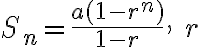
👉 Sum of an infinite geometric series 
👉 If three numbers are in A.P., then the middle term is called the arithmetic mean of the first and third terms.
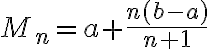
👉 Arithmetic mean (A.M.) between a and b, when n arithmetic means are inserted:
Last modified: Sunday, 10 May 2026, 8:32 PM